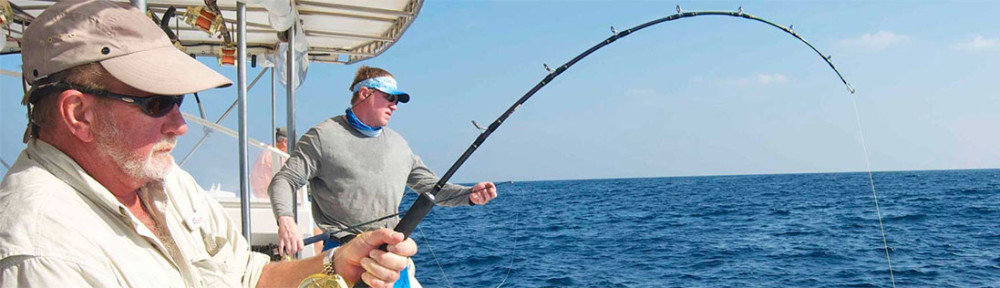
Fishing for Black Marlin

Species Article: Black Marlin

An angler’s first sight of a black marlin is an unforgettable experience: it is a magnificent fish weighing up to several hundred kilograms, and its size is matched by great power, speed and agility.  It’s therefore no surprise that the black marlin is much sought after by anglers from around the world who wish to take up the challenge of this spectacular fish with its renowned fighting qualities.

The Black marlin is at home in the tropical and sub-tropical waters of our Indian and Pacific oceans. They mostly swim in the surface layer of the sea, near land masses and in the vicinity of coral atolls. In Australia black marlin are distributed throughout the coastal areas of all states, with the most popular recreational fishing grounds being off Queensland, New South Wales and Western Australia. Black marlin can be caught almost all year round somewhere in Australia: on the east coast, for example, they are plentiful in north Queensland waters between July and November, off southern Queensland from November to March, off northern New South Wales from December to April and off southern New South Wales between January and May.

Although some tackle has been specifically designed for big game fishing, expensive and sophisticated equipment is not essential if you’re targeting juvenile marlin rather than really big ones.  A lever drag game reel is ideal Such as  A Shimano TLD 50 Two speed fishing reel stocked by our Online Fishing Tackle Shop would be a good choice and you’ll need at least 640 metres of line with break strength of 24kg to suit. A game style rod is ideal, such as the Shimano T-Curve 24kg Stand Up fishing rods for game fishing from a boat or if you are into land based game fishing then you could consider the Live Fibre RLF14 Land based game fishing rod.

The major food of black marlin is other fast-swimming fish species such as tuna, trevally and mackerel and a range of other bait fish. As opportunistic feeders, the black marlin consumes a lot of bait fish, and anglers take advantage of this feeding pattern when seeking out their targets. Some signs that bait is around include hovering birds and objects floating on the surface.

Trolling baits and lures, or a combination of these, are the most usual methods used by anglers to catch black marlin, with lures now being used increasingly in preference to live bait. Our Online Fishing Tackle Shop stocks a variety of marlin lures including the ever popular Pakula Lures range of trolling skirts with an enticing head shaking action. Lures are most effective when several are trolled in a pattern or otherwise known as a spread, but one or two lures can still work well.

The excitement when you hook a marlin is very special. If you win the battle with a marlin, the decision whether to capture or release the fish is yours.  Whatever you decide, you will have had a thrilling tussle with a very worthy opponent.

Check out some useful information on Pakula lure choice:

Flathead Lures | Fishing with Soft Plastic Lures

Fishing with Soft Plastic Fishing Lures for Flathead

Soft plastic lures are a great way to attract Flathead.  While the species is renowned for its laziness, it will put up quite a fight when hooked, and if you win the battle, Flathead make great eating.  Here are some tips for catching Flathead with soft lures.


Flathead are found in shallow water in estuaries and bays where they hide, camouflaged and partially buried in sand.  Rather than actively seeking food, Flathead wait for their prey to come to them, conserving their energy for the quick burst of acceleration that they make when an attractive morsel passes nearby.  By slowly trailing bait or lures along the bottom, anglers have the best chance of hooking Flathead.


Most of the types of lure that are successful with bream will work with flathead, too.  Soft plastic lures that attract bites from Flathead are generally at least 50 mm in length. Ocean Storm’s Online Fishing Tackle Shop stocks a range of fishing lures in soft plastic materials, such as Squidgies, as well as Berkeley Gulp fishing lures made from natural biodegradable materials. These lures look and feel like soft plastic and are impregnated with a scent that fish find irresistible.


Soft plastic lures come in a range of colours, and it’s useful to keep a variety of colours in your tackle box.  Many anglers find that dark coloured soft plastic lures in the same colours work better on dark days, while lures in lighter colours or more natural looking colours attract more bites from flathead on light days.  After a period with no results, changing the shape of lure you use, for example swapping a minnow shape for a grub shape, will often encourage flathead to take a bite.


When fishing for flathead, fairly simple tackle is adequate.  Your aim is to slowly work the bottom, so a 3-4kg line on a basic spinning reel is generally fine.  While a fibreglass rod isn’t suitable for use with soft plastic lures because of their action and lack of sensitivity, a basic 6-7 foot graphite fishing rod allows the angler to cast more accurately and gives the sensitivity to feel a nibble from the target.


When the weather is warm and the water is shallow, fishing for flathead can be very rewarding.  Flathead appear to be indolent until they’re ready to pounce on their prey.  Flathead don’t seem to be at all wary of lures – so using Soft plastic fishing lures can make for an exciting day of fishing.

Checkout this clip below for fishing for Flathead on soft plastic lures: Brett Wilson From Shimano is using the Squidgy Pro Lobby Lure

Also check out this Clip to further your knowledge and experience in targeting fish on soft plastic fishing lures.. You can buy the full Soft Plastic Tactics Fishing DVD in our online fishing tackle shop.

Fishing for Barramundi in the Northern Territory

It’s not hard to understand why anglers are so enthusiastic about fishing for barramundi, and why it’s considered to be one of the leading Australian sportfish and the most popular target of anglers in the Northern Territory. The fighting characteristics of this feisty species make for exciting sport, and as a bonus the fish itself has a reputation as a delicious table fish if caught in salt water and tidal rivers.

Barramundi can be caught all year round and if you’re travelling to the Northern Territory it is well worth taking some time to discover the best times and places to ensure you have the best angling experience.

The life cycle of this species leads it to inhabit a wide range of aquatic environments, in creeks, rivers and estuaries.  The fish matures in upstream areas of freshwater streams and moves downstream for spawning in coastal waters and estuaries.  Streams that have large catchments, a low continuous flow of water and warm water temperatures are ideal habitats for Barramundi, and they prefer to seek cover under mangrove roots, submerged logs, rock ledges and other underwater structures.


While live bait such as mullet and prawns appeals to these fish, and they are also often taken with heavy fly gear, medium sized minnow fishing lures in bright bronze or gold metallic colours are probably the most successful way to entice Barramundi out from heavy cover.

For trolling and casting for Barramundi with medium weight baits and lures, the most popular fishing reels are bait caster fishing reels.  When you’re fishing in billabongs and estuary flats, especially in windy conditions, you’ll find that smaller, lighter lures are more suitable; for casting light lures, spinning reels are ideal.

Whatever style of reel you choose, it will be fully tested when you hook an aggressive Barramundi, so it’s best to go for a high quality salt water grade reel and have it serviced regularly to prolong its life. Shimano T curve Power Spin with Saragosa 3000 Fishing Reel Combo is recommended by the Fishing Tackle Shop as an ideal heavy duty setup if you’re targeting Barramundi.

The Northern Territory seasons govern the style of Barramundi fishing.  During the wet season between January and March and the post-wet period from March to May, most anglers fish by casting from boats anchored in waterways. During the dry season, between June and September, fresh water lagoons and rivers become accessible to anglers.  At this time of year, when temperatures are cooler, Barramundi tend to stay in deep water. From October to December, during the run-up to the wet season, Barramundi become more active as water temperatures rise and fishing in freshwater lagoons and in salt water estuarine waterways can be very productive.

In tidal rivers, Barramundi tend to bite better towards the end of run-out tide while an hour or two either side of a low tide are good times to attract Barramundi in estuaries and salt water creeks.  And when you hook a Barramundi, be prepared for an exciting battle of wits and strength with a worthy opponent.  Shop Now for barramundi fishing tackle


Fishing with blade fishing lures article

Blade fishing lures have been around for more than half a century, and they’ve become immensely popular with anglers over the past few years. The lures work by transmitting vibrations through water to attract predatory fish. Here are some tips for getting effective results from blade lures.


Although blade lures are best known for catching bream and bass, their use is not limited to these two: they are great lures for other types of fish, both fresh water and salt water species, including flathead, bream, flounder, perch and tailor.  One of the reasons for their popularity is their versatility, since they allow both vertical fishing techniques and cast and retrieve methods.


Blades lures are quite heavy relative to their profile, and their ability to sink quickly makes them a good choice when fishing beside structures such as bridge pylons.  When fishing in snaggy areas where fish tend to congregate, it pays to be cautious when throwing a blade lure.  Because these lures have many hook points, cast carefully to avoid the frustration of snagging your lure in a weed bed or, much worse, losing it by fouling on submerged timber.


Retrieve techniques for blade lures depend on the fishing conditions. In shallow pools, wind the reel in slowly and steadily so that the lure alternates between lazy movements and more vigorous vibrations as the rod tip is lifted.  In deep, timber-free pools, the lure can be cast to the bottom then retrieved in a stabbing motion that causes aggressive vibration when you lift the rod. If you are unsure what structure may be lurking below the surface, a cautious vertical jig of a short line can be very effective.


Blade lures have variable tow points allowing the angler to adjust the action of the lure in different currents and depths.  Selecting the front tow point reduces the lure’s resistance during retrieval, and is good when you want some fast or jerky movement such as when fishing over shallow weeds for blackfish, or when jigging a lure quickly in search of flathead.  For increased resistance, select the middle or rear tow point, causing the lure head to tip down.  This action is good when fishing for bream or jewfish beside vertical structures like pylons.


In addition to their sonar qualities, blade lures come in bright colours and metallic finishes (some blade lures even have crystal eyes that reflect light) to attract fish visually.  If you’re looking for versatile lures that can be used in a variety of conditions to attract a wide range of fish species, blade fishing lures could be the ideal choice.

Some popular brands of blade fishing lures include:

Ecogear blade fishing lures, Riley’s Lures, TT Switchblade lures, Berkley big eye blades and Shimano Stiffy Devil Fish Vibe lures.

To check out Ocean Storm fishing tackle’s full range of blade fishing lures in the online fishing store see the following link:

https://www.fishingtackleshop.com.au/categories/Fishing-Lures/Bladed-Fishing-Lures/

Snapper Fishing – Species Article

Species Article: Snapper


Snapper is a saltwater fish popular with both recreational and commercial anglers fishing in the southern half of Australia.  Not only does snapper taste delicious, it’s renowned as a good fighting fish and is targeted by anglers who look for a real challenge.  Let’s look at some of the features of the snapper that make it such a prized catch.

Although many snapper that are caught weigh less than 3 kg, larger fish weighing up to 10 kg are there to be had, especially in South Australian waters.  Schools of small snapper are found in shallow bays and on gravel beds near the mouths of clean rivers, or in deeper water over reefs. The preferred habitat of larger fish is depths of 10 to 25 metres in bays, and offshore in depths between 20 and 70 metres. The most productive times for anglers targeting snapper are on a rising tide in the morning, late afternoon and early evening.  Weather conditions seem to make little difference to snappers’ readiness to take bait or lures, although some seasoned fishermen swear that the fish bite well in the half hour before a thunderstorm.

Snapper aren’t overly fussy about their food.  They’re opportunistic grazing feeders and tend to scavenge for whatever is readily available to them without too much effort.  Offshore they tend to favour live bait or soft plastic fishing lures such as berkley gulp Jerk shads, while inshore snapper seem to have a preference for a wide variety of dead bait.

Fishing rods specifically intended for anglers targeting snapper include the Shimano Rader Snapper Rod 762, available from the Fishing Tackle Shop online store.  This is a light two piece rod, a little over 7 feet in length, and designed to be used with a spin fishing reel.  When selecting a line, bear in mind the sensitivity to line diameter displayed by snapper, particularly smaller specimens.

The main challenge of snapper is actually hooking the fish: snapper tend to be easily spooked by any resistance on the fishing line when they first mouth bait.  For the best chance of catching snapper, consider using a free spooling technique and aim to allow the fish a couple of seconds to swallow the bait and be caught by the hook before striking.  For the same reason, it’s helpful to use sharp hooks when targeting snapper.

Fishing for snapper is great fun, and once you’ve hooked your fish it will put up a good hard fight. Capturing a good sized snapper will bring a smile to the face of even the most jaded of anglers.